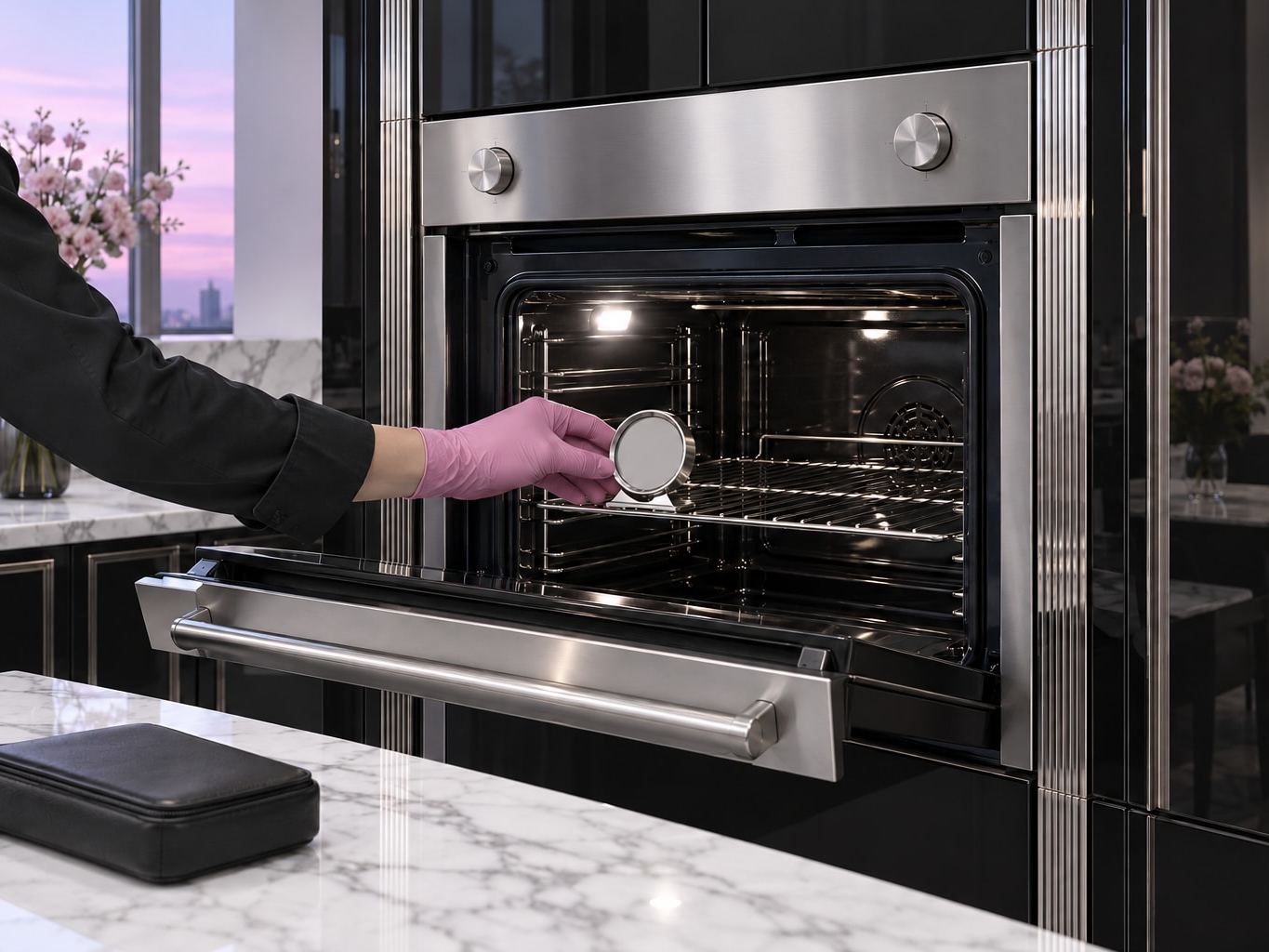
A built-in Wolf oven lives inside joinery: boxed in on three sides, wired from behind, often stacked over a second cavity, a steam oven or a warming drawer. Some faults announce themselves from the front at a glance; others stay hidden until the oven is eased out of its niche.
Who repairs Wolf built-in ovens on the Westside of Los Angeles?
Beverly Hills Wolf Specialists looks after Wolf built-in ovens, one cavity or two, in Beverly Hills and the neighboring areas listed further down. The call is $89 however many Wolf pieces the technician inspects; that sum is absorbed into the job, and the repair gets a price only after the oven has been put through its paces.
one
Faults that show from the front
Plenty of wall oven trouble can be read without moving anything. These are the patterns a technician looks for in the opening minutes of a visit, standing at the oven door.
Observed
The display stays dark and nothing chimes
Likely
No power arriving: a tripped breaker, a loosened supply connection behind the unit, or a failed control
Observed
The cavity creeps up but never reaches its set point
Likely
An open bake or broil element, a convection element burned through, or a temperature probe misreporting
Observed
Convection is selected, yet the rear fan sits motionless
Likely
The fan motor has seized or its lead has broken; the element wrapped around that fan may have failed as well
Observed
The door stays latched long after a self-clean
Likely
A lock motor or lock switch stuck mid-travel, or a control that never registered the cavity cooling down
Observed
The touch panel answers some presses and ignores others
Likely
Moisture or grease beneath the glass, a ribbon connector working loose, or the control itself
The cabinet face or the drawer above turns hot to the touch
Likely
The cooling fan has stopped or its vent path is blocked; switch the oven off and keep it off until it has been seen
In brieftwo of three
Why won’t my Wolf oven heat up?
Rule out the breaker before anything else. When the panel lights yet the cavity stays cool, the usual suspects are an element that has failed open, the temperature probe, or a board relay stuck open. Each one is measured on site; ordering parts by guesswork is how ovens end up with the wrong element.
two
What appears only once the oven slides out
A wall oven is fastened to its cabinet through the front frame and rests on the cabinet floor. Behind it sit the junction box, the supply cable, the terminal block where that cable lands, and the path the cooling fan uses to push warm air away from the woodwork. None of that is visible with the door open, and several common faults live exactly there.
A scorched terminal or a loose supply lug can make an oven cut out at high heat while looking perfect from the front. A cooling fan clogged with dust, or a cut-out in the cabinet that leaves the fan no room to breathe, lets heat build up behind the unit until the control shuts things down or the trim begins to discolor. Wiring pinched during an earlier installation can work fine for a long time and then fail without warning.
That is why the details of your installation matter before the visit. Tell us if custom panels or tight millwork wrap the oven, whether you have one cavity or two, and whether anyone on site can approve moving trim. Clearing the counter or drawer directly below makes the job calmer for everyone. Most of the time the oven never needs to come out; when it does, knowing in advance keeps the visit short and the cabinetry safe.
three
From the doorbell to the test bake
At the door
The technician hears the story first: what the oven did, when it started, and which mode was running at the time.
In front of the oven
Bake, broil and convection are run in turn, and the readings on the display are compared with what is actually happening inside the cavity.
If the fault is hiding
The oven is eased forward out of its niche so the terminal block, the cooling fan and the wiring can be reached and tested.
Before anything is replaced
You hear a single figure for the repair. The visit charge of $89 is credited toward it, and going ahead is entirely your decision.
Once the repair is done
The oven is heated back up and watched through a full heating cycle, then slid home and trimmed in before the technician leaves.
In briefthree of three
Wolf oven door locked after self-clean: how do I release it?
Give it time first: the latch holds until the cavity has cooled far below cleaning heat. If the interior is cold and the door still refuses, switching the oven’s breaker off, pausing briefly and switching it back on often resets the lock. Never force the handle; a bent latch turns a reset into a repair.
Three beliefs worth retiring
Hearsay
A cold oven always means a dead heating element.
In fact
On a Wolf wall oven that symptom can equally trace back to the temperature probe, a relay on the board, a door lock that never released, or a loose supply connection. A meter decides; replacing the element first is a coin toss.
Hearsay
Self-clean is the kindest way to keep a Wolf oven spotless.
In fact
Self-clean runs extremely hot and puts the lock, the door seal and the electronics through their hardest cycle. Wiping spills as they happen and saving self-clean for real build-up spares those parts. If a cycle ever ends with the door stuck, leave the handle alone and call.
Hearsay
Steam, convection and combination cooking are all one repair.
In fact
Convection in a wall oven is a fan and an element. A Wolf convection steam oven adds water handling and descaling on top of that, which is its own trade; see steam oven repair.
four
Wall oven repair, neighborhood by neighborhood
Built-in ovens sit in very different kitchens across our area. Each of these pages looks at Wolf wall ovens in one of them.
New and restored kitchens where ovens go into freshly built cabinetry.
five
Wall oven questions we hear most
Will my cabinetry get damaged if the Wolf oven has to come out?
Sliding a built-in oven forward is routine work, done with care for the face frame and surrounding trim. If custom panels or close-fitting millwork wrap the oven, say so while booking and the technician will come ready for it.
My Wolf oven crawls up to temperature. What slows the preheat?
A slow climb usually means one heat source has dropped out, leaving the others to carry the load: a failed broil or convection element, a weakened bake element, or a probe that misjudges the cavity. A worn door seal also lets heat escape at the front.
One half of my double oven works and the other doesn’t. Is that two visits?
No: one trip, one $89. The two cavities share some parts and keep others separate, so the technician tests both and quotes whatever each one needs.
What should I note down before the technician arrives?
Jot down the model and serial numbers from the rating label, often found on the oven frame once the door swings open, plus any message on the display, the mode that was running and whether a breaker tripped. A photo of the screen helps more than a description.