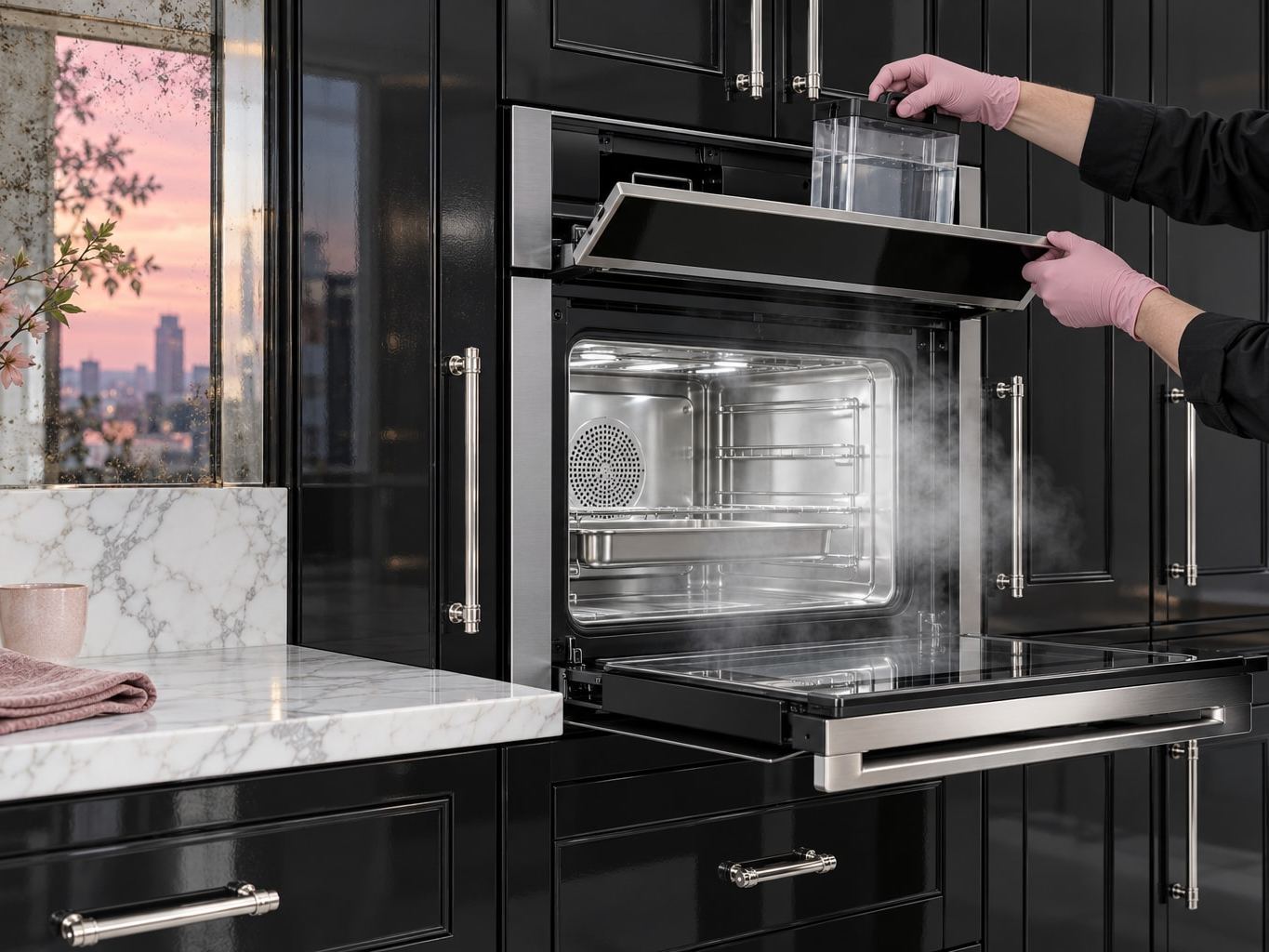
A Wolf convection steam oven asks more of itself than any other cavity in the kitchen: it boils water, circulates hot air and follows a probe, sometimes all within one recipe. When it complains, the complaint nearly always belongs to one of those three systems.
The idea behind the CSO is simple even if the hardware is not. You fill a reservoir, in the way and to the level your model’s use-and-care guide describes. The oven draws that water, turns it into steam and releases it into the cavity, while a fan and a heating element supply the dry heat of convection. Combination modes blend the two, and the probe lets the oven cook to the temperature at the center of the food rather than to a timer.
Most service calls begin on the water side. Everything water touches, from the reservoir’s seat and the pump to the steam generator, its hoses and the drain path, is exposed to the minerals carried in ordinary tap water. Those minerals settle as scale, and the oven keeps track of it and asks for a descaling cycle when the time comes. Postponing that request again and again is how many steam faults begin.
The convection side behaves much like a conventional wall oven, with a fan, an element and a temperature sensor that can each wear out. The probe is the quietest of the three systems: when it fails, the oven either shows a reading that makes no sense or ends a cooking program before the food is ready. A pinched cable or moisture in the socket inside the cavity wall is a frequent cause.
Three systems, two kinds of answer
Some steam oven complaints are cured by the care routine in the manual; others need a technician. The table separates them.
Wolf convection steam oven systems, the complaint and what it usually calls for
System
Typical complaint
Care by the manual, or a repair?
Water supply
A request for water even though the reservoir is full
Reseat the reservoir as the manual shows; if the request persists, a sensor or pump fault needs repair
Steam generation
No visible steam, food coming out dry in steam modes
Descale if the oven has asked; if steam stays absent afterward, the generator or its heater needs repair
Drain and condensate
Water standing in the cavity or appearing beneath the oven
Dry the cavity after steam cooking as the manual describes; a leak from underneath is a repair
Convection heat
Dry modes slow to heat or browning unevenly
Repair: the fan motor, the convection element or the temperature sensor
Probe and controls
Odd probe readings, programs ending early
Push the probe fully into its socket; a damaged probe, socket or control needs repair
Door
Steam escaping around the door edge
Clean the gasket the way the manual explains; a torn gasket or a sagging hinge needs repair
In briefone of three
Who repairs Wolf steam ovens across the Westside of Los Angeles?
Beverly Hills Wolf Specialists fixes the Wolf CSO, the convection steam oven, in Beverly Hills and across the ten other areas on our map. A trip is $89 no matter how many Wolf pieces the technician inspects, and that charge goes toward the work; a repair price follows once water, heat and probe have each been tested.
two
Signs, sorted by system
Each sign below points first at one of the three systems. That does not settle the diagnosis, but it gives the technician a starting place.
Observed
The oven keeps asking for water with the reservoir full
Likely
The reservoir is not seated all the way, a contact is dirty, or a level sensor or the pump has failed
Observed
Steam mode runs, yet the cavity stays dry
Likely
Scale choking the steam generator, or a pump or heater that is failing
Observed
Descale reminders return soon after a descaling cycle
Likely
The cycle was interrupted before it finished, or the part that tracks scale is misreading
Observed
A puddle forms under the oven or on the cabinet floor
Likely
A leaking internal hose or joint, overflow from a reservoir sitting crooked, or a blocked condensate path
Observed
Clouds of steam roll out around the door
Likely
A gasket torn, squashed flat or slipped out of its channel
Observed
Convection cooking is slow and uneven
Likely
A fan motor or convection element losing strength, as in a regular wall oven
The probe shows nonsense or cooking stops too soon
Likely
Damage along the probe cable, or moisture inside its socket
Care that belongs to you
The use-and-care guide for your model is the reference for how often and with what; we do not set our own intervals. Within that guide, these habits prevent most water-side trouble.
Fill the reservoir with whatever water the manual specifies, up to the marked line and no further
Slide the reservoir fully home until it seats
Run the descale program whenever the oven requests it, with the agent the manual names
After steam cooking, dry the cavity and door seal as the manual describes
Empty the reservoir after use if your manual recommends it
Keep the probe clean and push it all the way into its socket
Leave panels and internal water lines alone; anything behind the cavity wall is service work
In brieftwo of three
Why is my Wolf convection steam oven not steaming?
Usually scale has built up in the steam system, or the reservoir is not seated, so water never reaches the generator. Reseat the reservoir and run descaling if the oven has asked for it. If steam modes still give no steam, the pump, the steam generator or its heater needs testing by a technician.
three
Steam oven questions people ask
Can I put filtered or bottled water in my Wolf steam oven?
Use the water your model’s use-and-care guide calls for. The type of water changes how quickly scale forms, but the manual’s guidance is what the oven was designed around, so we do not recommend anything beyond it.
Is it normal for droplets to collect inside the door after steaming?
Yes. Steam condenses on cooler surfaces, so beads of water on the inner glass and in the cavity are expected; wipe them away once the oven has cooled. Water outside the oven, on the cabinet or floor, is not normal.
Can I keep using convection while the steam side is broken?
If the dry modes work normally, there is no leak and no error stops the oven, convection-only cooking is usually fine until the visit. Stop using the oven altogether if water shows up outside it or the controls start behaving strangely.
New kitchens where the steam oven is among the first appliances to be used.
In briefthree of three
Why is my Wolf steam oven leaving water on the floor?
Check first that the reservoir is seated and filled no higher than its mark, and that the door seal is intact. Water under the oven or on the cabinet floor otherwise points to an internal hose, joint or drain path. Stop steam cooking, dry the area, keep water away from outlets and book a visit.