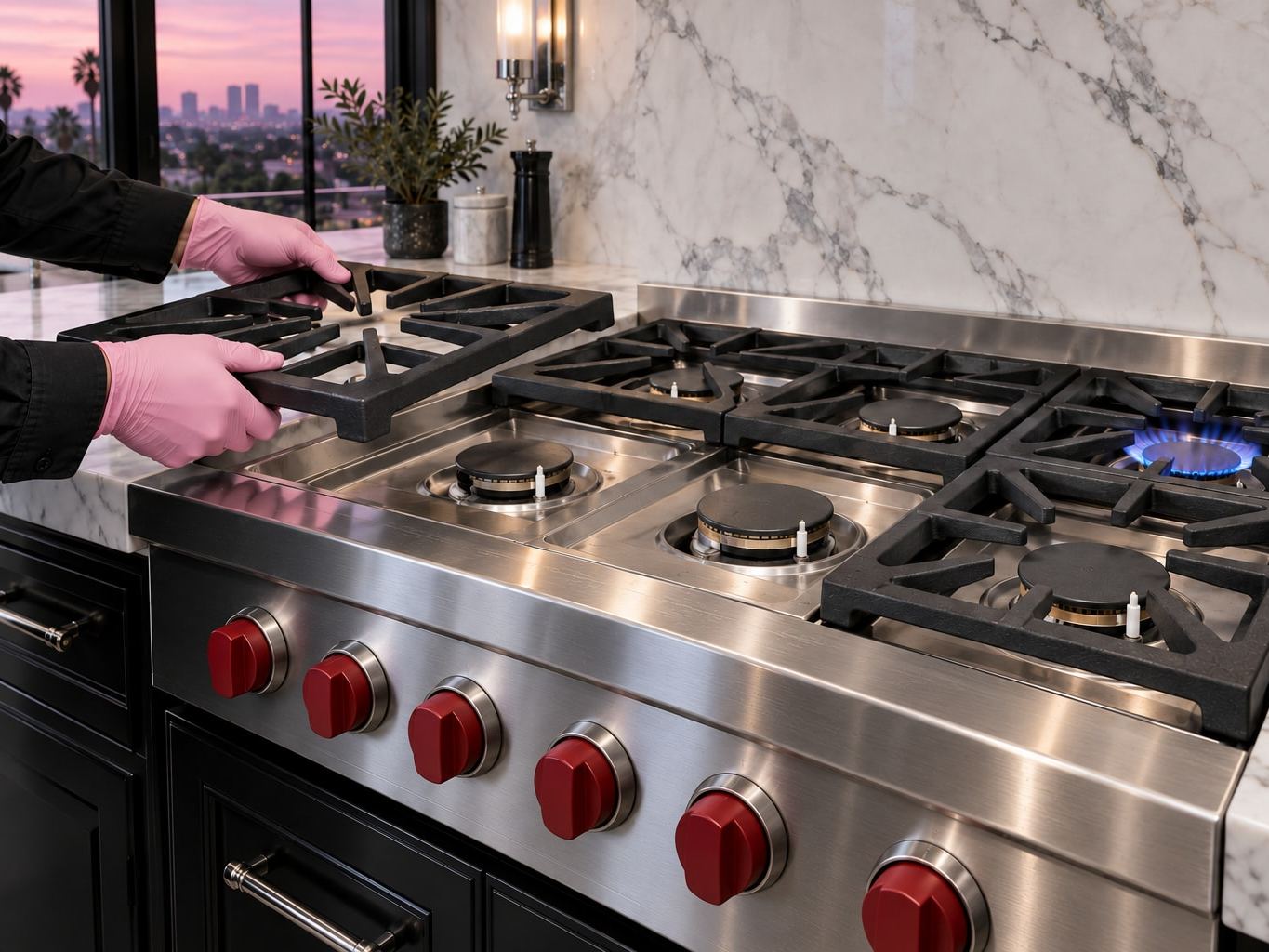
Under one stainless frame, a Wolf range holds several machines at once: a row of sealed burners, sometimes a griddle or charbroiler, one or two ovens, and the controls that link them. Tell us which of those sections misbehaves and the visit begins exactly there.
Owners usually describe a range fault as “the stove is broken.” Naming the misbehaving part helps far more, because each section carries a separate set of components and a separate shortlist of culprits. This is how a technician splits the range up before reaching for a meter.
Wolf range sections, the complaint owners notice, and what gets tested
Section
Owner’s report
Checked on site
Dual-stacked sealed burners
Clicking with no flame, a ring lit along just half its edge, a low simmer that dies away
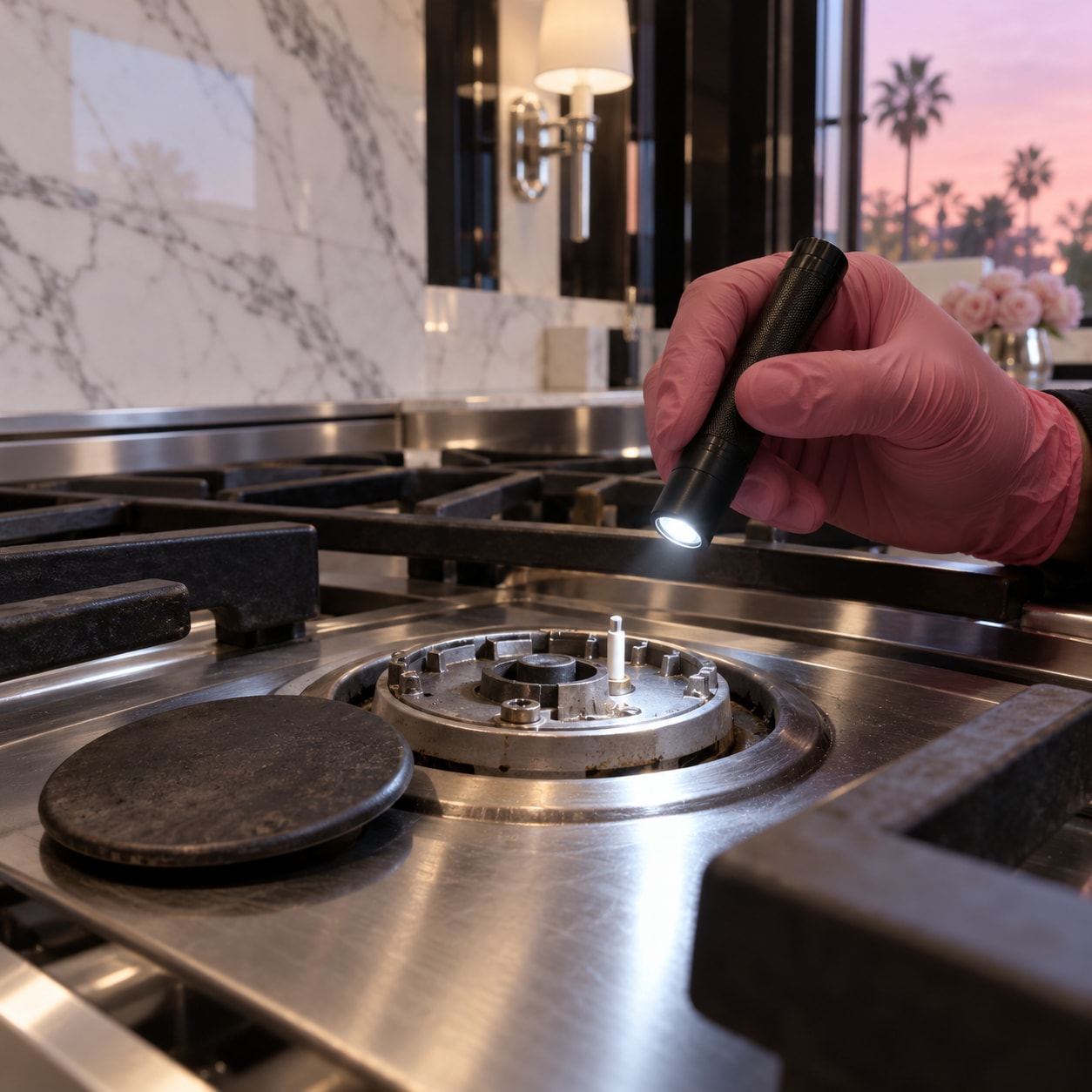
Cap seating, clogged ports, electrode gap and lead, the spark module, the valve behind that knob
Griddle or charbroiler, where fitted
Patchy heat across the plate, a flame that drops out
The heating element or burner, the griddle thermostat, grease lodged near the ignition
Oven on an all-gas range
Sluggish preheat, no heat whatsoever, an igniter glowing orange while the burner stays dark
Igniter draw, the oven safety valve, the temperature probe, bake and broil burners
Oven on a dual-fuel range
The electric cavity stalls below its set point, the convection fan never spins
Bake, broil and convection elements, the fan motor, the probe, relays on the control board
Induction top and the controls
A zone blind to the pan, an error code flashing, knobs glowing yet doing nothing
Pan detection, the power board, the cooling fan, supply at the junction box, the harness
In briefone of three
Is there a Wolf range specialist serving the Westside of Los Angeles?
Yes: Beverly Hills Wolf Specialists handles Wolf ranges of all three kinds, gas, dual fuel and induction, from Beverly Hills out to Santa Monica, Pacific Palisades and Hancock Park. A single trip is $89 flat, whether the technician examines one burner or every Wolf appliance on the premises; the charge is folded into the repair, and the price of that repair is named after inspection, never mid-job.
two
Reading the range’s complaints
A handful of signs turn up on Wolf ranges again and again. No single one settles the matter, yet each shortens the search.
Observed
The igniter keeps snapping after the flame has caught
Likely
Moisture from a boil-over around the electrode, or a knob switch that has stuck in the on position
Observed
Only part of a burner ring catches
Likely
The cap rests crooked or food residue has sealed some ports; on a stacked burner the upper and lower rings can quit independently
Observed
The flame looks lazy and yellow rather than crisp and blue
Likely
A shifted burner base, residue in the ports, or a combustion air issue that needs eyes on site
Observed
Burners fire normally while the oven underneath stays cold
Likely
On gas models a weak oven igniter or safety valve; on dual-fuel models an element, the probe or a relay
Gas, dual fuel and induction call for different hands
The badge on the front reads Wolf either way, but inside, each type is its own trade. Knowing which one sits in your kitchen sets expectations for the repair.
Gas and dual-fuel tops
Trouble lives in the ignition chain: electrode, lead, spark module, knob switch
Flame quality depends on clean ports and a cap resting perfectly level
An all-gas oven relies on a glowing igniter drawing enough current to open its valve
A dual-fuel oven bakes on electric elements, so its faults are electrical though the top burns gas
Induction tops
No flame, no igniters: heat comes from coils beneath the glass and the boards driving them
Pan detection decides whether a zone wakes up at all
Cooling airflow matters, since the electronics dislike heat
Codes appear on the display, handing the technician a starting point
Our viewWhatever the type, the method holds: run each section, catch the one that fails, then test the components inside it. Swapping parts on a guess costs owners more than a proper test.
four
How a range visit goes
You call or bookSomeone answers 24/7. Describe the range type, the section at fault and what happened, and we set a visit for 8 AM to 6 PM, every day.
The range runs firstEvery burner, plus any griddle or charbroiler, and each oven get switched on, so the failure shows itself in front of the technician.
Components get measuredIgniters, valves, elements, probes and boards in the failing section are tested with instruments, never replaced on a hunch.
You hear one totalYou get one figure for the repair before a single screw turns; the decision is yours, and the $89 is credited against it.
Repair, then a test fireOnce the part is in, the section is lit again and watched until it behaves. Should a component need ordering, you hear that plainly and a second trip goes on the calendar.
Gas is the one exception to troubleshooting
Smell gas? Leave first
Gas in the air? Walk out first
Hands off the knobs, the shut-off, every switch and plug, and the windows. Do not hunt for the source. Gather everyone and leave the house, cross to the street, and from there ring the gas company or 911. Range work resumes after the gas line is declared sound.
No switch flipped and no appliance unplugged on the way out
The call happens from the sidewalk or the driveway, not the hallway
Repair is postponed until the line is cleared
In brieftwo of three
Wolf range burner not lighting, only clicking: what now?
Most often the cap sits askew on its base, a boil-over has gummed the ports, or the electrode is still wet from wiping. Let the cooktop dry out, set the cap level and try again. Persistent clicking with no flame means the igniter, its lead or the spark module needs a meter.
five
Range repair by neighborhood
Each area we serve has its own kind of kitchen. These pages look at Wolf ranges in each one.
Kitchens being restored and rebuilt, where a range often connects to new gas work.
In briefthree of three
My Wolf dual-fuel oven won’t heat but the burners work. Why?
On a dual-fuel model the top burns gas while the oven bakes electrically, so working burners above a cold cavity point at the electric side: a bake or convection element that has burned through, the temperature probe, or a sticking control-board relay. Rule out a tripped breaker, then book a visit.
six
What range owners ask us
Burners fine, oven dead: may I keep cooking on top of my Wolf range?
Usually, provided there is no sparking, no breaker that keeps dropping and no gas odor. Cooktop and oven share a chassis but not their working parts, so a dead oven seldom drags the burners down with it. If anything feels wrong, leave the range off until someone has looked.
Do you take on Wolf ranges that have been discontinued?
Yes; age alone is no reason to turn a range away. Whether a given component can still be sourced gets checked during the inspection, and you will know before you agree to anything.
How do I wash Wolf burner caps without upsetting the ignition?
Let everything cool, lift grates and caps, and scrub the caps in the sink instead of on the cooktop. Keep liquid off the white ceramic igniter, towel each piece completely dry, and seat every cap level before you light anything.
My Wolf wall oven is misbehaving as well. Two charges?
One. The $89 covers the trip itself, so while the technician is on site the range, a Wolf wall oven and any further Wolf piece in the kitchen can all be looked at. Each repair is then quoted on its own.
Repair or replace: which makes sense for a Wolf range?
That turns on which part failed and the quoted total, so you get the number before deciding. Igniters, valves, elements and boards are swappable components, and the pricing page walks through the cost drivers.