Wolf service · Ventilation

Wolf Hood Repair

A Wolf hood rarely fails in a dramatic way. It gets louder, pulls less, loses a light or ignores a button, and the cause can sit in the canopy, in a blower tucked into an attic or onto a rooftop, or in the duct between them. The first job is finding out which.

4.8 out of 5, 187 client reviews Where this score comes from

In briefone of three

Wolf hood fan won't turn on — what's wrong?

Lights on but fan silent: think blower motor, its start capacitor, wiring out to a remote blower, or the control board. Hood completely dead: check the breaker first. If that is fine, the remaining causes need a meter and a ladder, so book a visit.

Four complaints, four separate lists of causes

Almost every call about a Wolf hood comes down to one of four complaints: noise, weak pull, lights, or controls. Each points somewhere different, which is why we ask which one you have before the visit.

  • Observed

    A rattle or buzz that climbs and fades as you change speeds

    Likely

    A loose baffle filter, a blower housing screw that has backed out, or grease build-up throwing the fan wheel off balance

  • Observed

    A new roar or whine this season

    Likely

    Worn blower motor bearings; when the blower is remote or in-line, its sound can travel down the duct and seem to come from the hood

  • Observed

    A flapping or knocking sound when the fan starts or stops

    Likely

    The backdraft damper sticking open and slapping shut, either at the hood collar or out at the exterior cap

  • Observed

    Smoke drifts past the canopy even on the highest setting

    Likely

    Grease-clogged filters, a half-open damper, or a duct partly blocked or crushed somewhere along its run

  • Observed

    The fan sounds strong but barely moves air

    Likely

    The exhaust is trapped: a closed or stuck exterior cap, debris in the duct, or a tight house starving the hood of replacement air

  • Observed

    One light out, or all of them flickering

    Likely

    A failed lamp, a loose lamp socket, or a lighting transformer or driver that is starting to fail

  • Observed

    Lights and fan both dead

    Likely

    Supply power first, the breaker panel next, then an unresponsive control board

  • Observed

    Fan stuck on one speed or will not turn off

    Likely

    A failing control board or switch, or a heat sensor that keeps calling for the fan after the cooktop has cooled

  • Observed

    A downdraft vent that refuses to come up, or freezes partway

    Likely

    The lift motor, its drive or its limit switches, or an obstruction behind the cooktop

    See the repair page

When the fan stops

In brieftwo of three

Who does Wolf range hood repair on the LA Westside?

Beverly Hills Wolf Specialists repairs Wolf hoods and downdraft ventilation across Beverly Hills and ten neighboring cities and districts of the Westside and central Los Angeles. A technician tests the fan, controls, lights, filters and duct path, then quotes the fix up front. The $89 trip charge counts toward that repair when you approve it.

Where your blower lives changes the repair

Wolf ventilation comes in a few broad layouts. The layout decides what the technician carries up the ladder and how much time access takes.

Blower inside the hood

  • Wall, island and pro-style canopies with the motor built into the hood body
  • Noise and vibration are heard right above the cooktop
  • Motor, controls and lights are reached from below, after the filters come out
  • Usually the most direct repair to diagnose

In-line, remote or downdraft

  • The blower is mounted along the duct run — attic, rooftop or exterior wall
  • Quieter in the kitchen, but faults hide farther away from the hood
  • Access may mean an attic hatch, a roof ladder or a cabinet under the cooktop
  • Downdraft vents have their own motorized lift behind the burners

Our viewTell us on the phone where the motor is, if you know. If you do not, a photo of the hood and its label helps, and the technician identifies the setup on arrival.

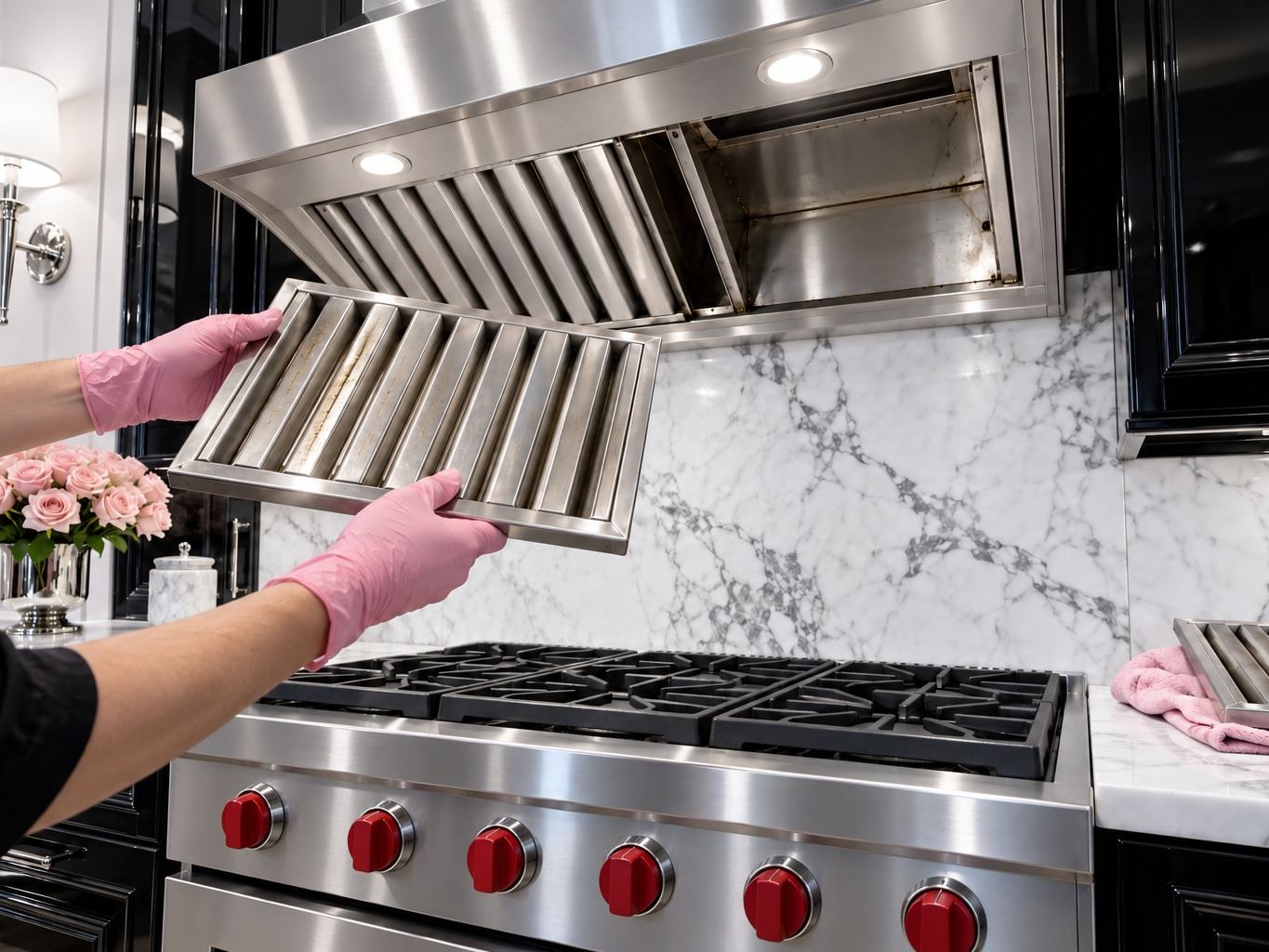
Technician in pink gloves lifting a stainless baffle filter out of a Wolf hood above a six-burner range with red knobs, a second filter resting on a pink cloth

The lights question

In briefthree of three

Why are my Wolf hood lights not working?

Start with the simplest cause: a burned-out lamp, replaced the way your owner's manual describes. If a fresh lamp stays dark, or the lights flicker, dim or quit together, the fault is more likely a socket, the lighting transformer or driver, or the control board, and that needs a technician.

The hood, the duct and the cap are three different problems

A hood can only push air into the path it is given. Behind every Wolf canopy there is a duct that runs through cabinets, ceilings or walls and ends at an exterior cap up top or on a side wall. When pull drops, the cause is often somewhere along that path rather than in the appliance: a damper flap that has seized, a nest or leaves in the exterior cap, a section of duct crushed during other work, or a run with so many bends that the fan never had much to work with.

Air also has to come in to go out. Modern homes are sealed tightly, and a powerful hood running on high can pull hard against the house. Signs of that are a whistle at the hood, a door that is harder to open while the fan runs, or a fireplace drawing backwards. That is a question of replacement air for the house, not a fault in the hood.

On a visit we separate those layers. We check the fan, controls, lights and filters on the Wolf unit itself, confirm the damper opens, and look at the duct and cap as far as safe access allows. If the hood is healthy and the limit is in the ductwork or the building, we say so plainly and walk you through the findings. Nobody should pay to replace a motor that was never the problem.

Grease is the shared enemy. Wolf baffle filters are designed to be taken down and washed regularly; when that slips, grease coats the fan wheel and the duct walls, adding noise and fire risk. Clean filters are the cheapest ventilation repair there is, and the first thing our technician checks.
How a ventilation visit runs

  1. Tell us which complaint Call (310) 496-3358 any hour or book online. Noise, weak pull, lights or controls — and where the blower is, if you know — is enough to plan the visit.
  2. Pick a window Visits run 8 AM to 6 PM, every day. If today's calendar still has a gap, same-day can work; if not, you choose the earliest slot that fits your household.
  3. Diagnosis at the hood and beyond The technician tests the fan at each speed, the lights and the controls, checks filters and damper, and follows the duct path where it can be reached safely.
  4. A quote you approve The technician explains the fault and quotes the repair, and you decide. The $89 is charged per trip, not per appliance, and rolls into the repair once you say yes.
  5. Repair or a clear next step When the needed part is available, the repair can be finished that day; when it must be ordered, we set a return appointment with you. A building-side problem gets a straight explanation instead.

Questions people ask about Wolf ventilation

My Wolf hood got noisy — is that a safety problem?

Usually just a nuisance at first. But a fan wheel caked in grease or a motor with failing bearings tends to get worse, and grease in the system is a fire risk. Switch the hood off if it starts to grind or smells hot, and book a look.

Can I keep cooking if my hood fan stopped?

You can, but go easy on high-heat searing and wok cooking until it is fixed, and open a window for fresh air while you cook. Without extraction, smoke, heat and grease settle on cabinets and ceilings.

How often do Wolf baffle filters need washing?

Use the interval in your Wolf owner's manual as a starting point, then adjust for your cooking. Nightly searing and frying loads them much faster than gentle simmering. If the filters look glossy with grease, they are due.

Do you look at the duct and roof cap too?

Yes, as far as safe access allows, because many weak-pull complaints end there. You will know whether the fault lives in the Wolf hood itself or somewhere past it before anything is quoted.

Can the technician check my Wolf range during the same trip?

Yes. The $89 is charged once per trip, regardless of how many Wolf appliances get checked, so add the range, oven or cooktop to your booking notes.

Hood service across the Westside

Every neighborhood builds its kitchens a little differently, and that shapes how a hood is ducted and reached. Pick yours, or read on about the rest of the kitchen.

  • Local service

    Beverly Hills

    Large open kitchens with island canopies and ducts snaking a long way above the ceiling.

  • Local service

    Bel Air

    Hillside estates where blowers and caps can sit on roofs that take planning to reach.

  • Local service

    Holmby Hills

    Show kitchens and separate catering kitchens, sometimes with more than one hood.

  • Local service

    West Hollywood

    Compact kitchens and condos where duct paths are short and tightly boxed in.

  • Local service

    Century City

    High-rise residences where the building controls what happens past the hood.

  • Local service

    Brentwood

    Busy family kitchens whose filters fill up fast.

  • Local service

    Westwood

    Wilshire Corridor towers and hillside homes, each with its own access rules.

  • Local service

    Hancock Park

    Older homes where modern ducting was threaded through original walls.

  • Local service

    Los Angeles

    Across the wider city, from hillside houses to downtown lofts.

  • Local service

    Santa Monica

    Salt air near the ocean is hard on exterior caps and dampers.

  • Local service

    Pacific Palisades

    Coastal canyon homes, including kitchens being rebuilt and recommissioned.

  • Wolf service

    Wolf range repair

    Burners, ignition and the oven under the cooktop that the hood sits above.

  • Pricing

    How pricing works

    A single trip charge that rolls into the repair, and a quote you approve first.

  • Article

    Fan noise elsewhere in the kitchen

    Condenser fans belong to refrigeration, not to Wolf cooking: how to tell that hum apart from a hood.